
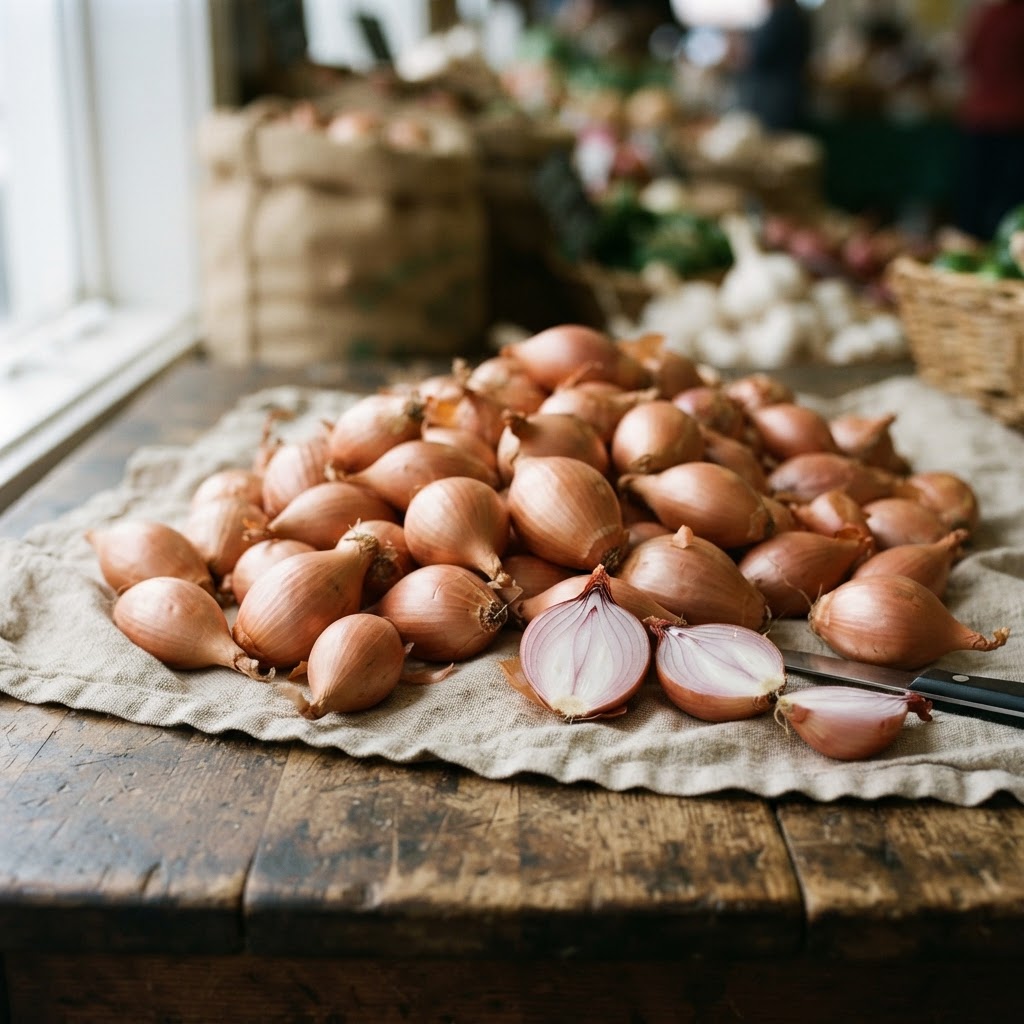
The Shallot
The shallot is a small clustered bulb, milder and more aromatic than the onion. It grows in cloves like garlic but tastes like a refined onion, and it is the allium most cooks reach for when they want sweetness without bulk. This page follows the shallot from field to plate: how to choose it, why it caramelises so cleanly, and where its subtle flavour is best used.
Varieties
Jersey / traditional shallot
- Looks
- Small, teardrop-shaped bulbs with copper-brown skin, growing in clusters.
- Taste & texture
- Delicate, sweet and subtly pungent.
- Best for
- Sauces, dressings, fine dicing, pickling.
Banana shallot (Echalion)
- Looks
- Longer, torpedo-shaped, copper skin; a cross of shallot and onion.
- Taste & texture
- Mild and easy to peel; larger cloves.
- Best for
- Roasting whole, braises, quick peeling.
Red shallot
- Looks
- Pink-red skin, small cloves.
- Taste & texture
- Slightly sharper; pretty when sliced raw.
- Best for
- Raw salads, pickling, garnish.
Grey / griselle shallot
- Looks
- Greyish, irregular bulbs; considered a gourmet type.
- Taste & texture
- Intense, rich and deeply aromatic.
- Best for
- French cooking, raw finishing, vinaigrettes.
Seasonality
Northern Europe
Harvest July–September; cured bulbs store September–MarchSouthern Europe / Mediterranean
Harvest June–August; storage through winterNorth America
Harvest late summer; storage through winterRipeness & freshness
Firm cloves
Firm, plump bulbs with dry papery skin.
No sprouting
No green shoots; sprouting signals age and bitterness.
Closed neck
A dry, twisted, closed neck; a soft neck means poor keeping.
Skin intact
Copper skin dry and unbroken; no soft or mouldy patches.
What to look for when buying
Choose firm
Heavy, firm bulbs with tight papery skin.
No soft spots
Reject soft, mouldy or sprouting bulbs.
Aroma
A refined, mild onion smell; avoid a damp, sharp or mouldy whiff.
Cluster intact
Shallots often grow in clusters; choose bulbs with dry, closed skins.
Growing, sourcing & harvest
Planting
Plant sets in early spring or autumn in free-draining soil; shallots multiply into clusters.
Harvest
Lift when the tops yellow and fall; cure dry for 2–3 weeks.
Climate
Prefer a long, mild growing season; too much water late on shortens storage.
Harvest & post-harvest
- Cured shallots keep for months in cool, dry, dark conditions.
- Once peeled, use within a few days.
- Smaller bulbs often store better than large ones.
Storage
Cool, dark, dry and airy; not refrigerated; keep away from potatoes.
Refrigerate wrapped and use within a few days, or freeze whole.
Cool and refrigerate; use within 2–3 days.
Raw & cooked, and how to cook it
Flavour
Raw
Delicate, sweet and mildly pungent; less sharp than onion.
Cooked
Deeply sweet and aromatic; caramelises cleanly to amber.
Texture
Raw
Crisp and fine-grained.
Cooked
Soft and silky; melts smoothly into sauces.
Colour
Raw
Pale layers under copper or pink skin.
Cooked
Golden amber when caramelised; red shallots turn soft pink-brown.
Fine dicing, raw
A refined allium base for sauces and dressings without onion's harshness.
Chef's note —Mince very fine for vinaigrettes; the flavour is gentler than raw onion.
Slow caramelising
Concentrates sweetness; shallots caramelise more evenly than onion.
Chef's note —Low heat, a little butter, patience; they turn glossy and amber.
Roasting whole, peeled
Dry heat intensifies sweetness; the cloves turn soft and jammy.
Chef's note —Toss in oil at 200 °C; shallots cook faster than onions.
Pickling
Acid sets the colour and sharpens the sweetness.
Chef's note —Whole peeled or halved in hot vinegar; good in salads and sandwiches.
Flavour & texture notes
- Delicate and sweet allium
- Refined, less pungent than onion
- Crisp and fine raw
- Soft and silky when cooked
Flavour notes & harmonies
The top flavour notes of the shallot and what each one harmonises with in dishes. On the left, the strongest notes of the shallot, sized by strength. On the right, the notes outside its profile that each one pairs with most strongly, with the harmony score of each pair.
Each block on the left is one of the top notes, sized by its strength. A stronger note shows more of its harmonies. Bars show the harmony score out of 10. Flavour notes and harmony pairings are curated from verified flavour-pairing reference data.
Colour & plant compounds
Shallots share the allium family's sulphur compounds in a milder, sweeter balance, and carry quercetin in their skins. Pink-skinned varieties add anthocyanins. Their high sugar-to-sulphur ratio is why they caramelise so cleanly. The evidence on absorption of these compounds from a meal is mixed and figures should be treated with caution.
Sulphur compounds (thiosulfinates)
Organosulfur CompoundsWell establishedPresent in a milder balance than onion; responsible for the gentle allium aroma.
Quercetin
FlavonoidsWell establishedFood scienceConcentrated in the papery skins; heat-stable compared with many compounds.
Anthocyanins
FlavonoidsWell establishedFood sciencePink pigment in red shallots; water-soluble, so colour leaches into pickling liquid.
Waste reduction
Save the skins
Papery skins add colour and flavour to stock and infused oils.
Caramelise a batch
Cook surplus shallots to a jam and keep refrigerated for sauces and toast.
Use the trimmings
Root and skin trimmings flavour stock; strain before serving.
Sources
United States Department of Agriculture