
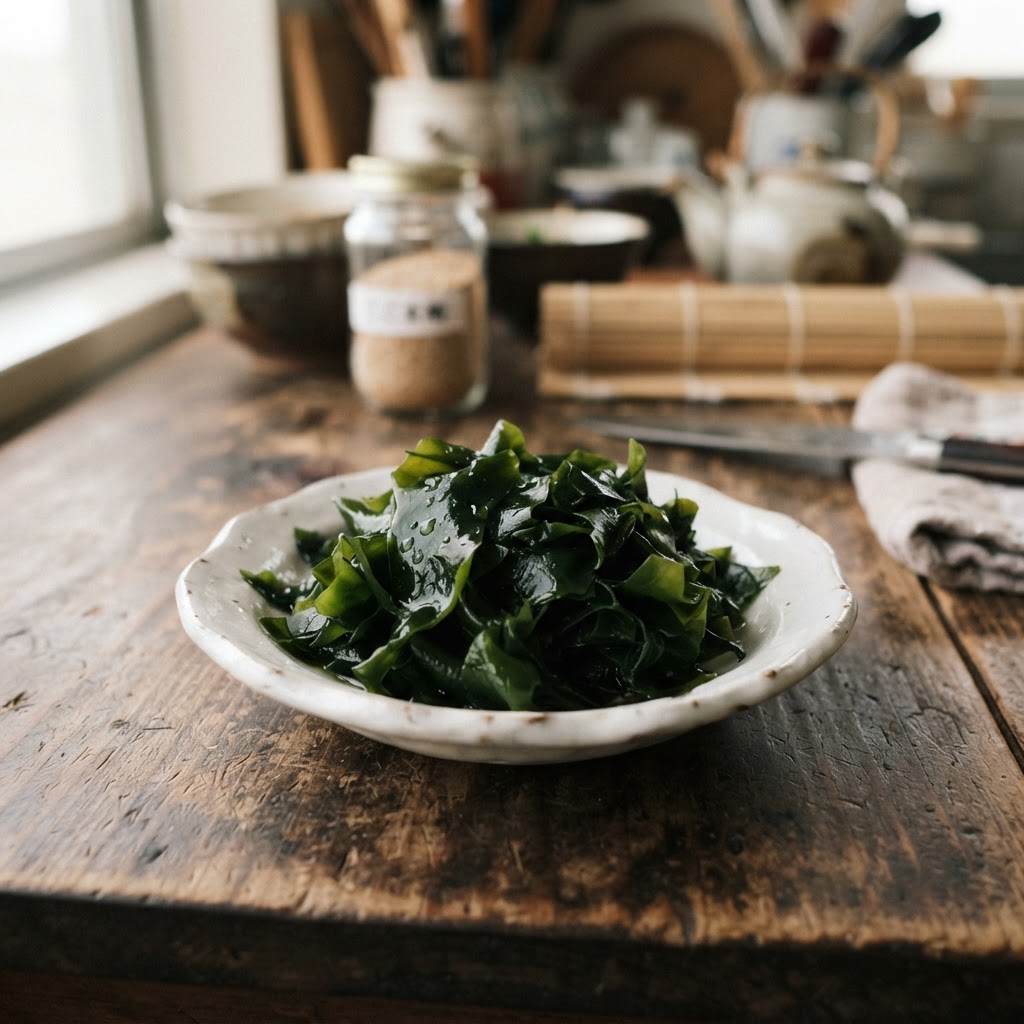
The Wakame
Wakame is a brown seaweed (Undaria pinnatifida) sold dried and rehydrated into dark green, silky fronds. It is the seaweed in miso soup, the bright green ribbons in seaweed salad, and a quiet source of the carotenoid fucoxanthin. This page follows wakame from sea to bowl: how it is farmed and dried, why a little rehydrates to a lot, and what gives it its silky texture and marine aroma.
Varieties
Dried wakame (standard)
- Looks
- Dark green-brown dried fronds; rehydrate in water.
- Taste & texture
- Mild and marine; the everyday wakame.
- Best for
- Miso soup, salad, broth.
Pre-cut dried wakame
- Looks
- Pre-cut into strips; rehydrates in seconds.
- Taste & texture
- Quick and convenient; the most common form.
- Best for
- Soup, salad, instant use.
Wakame stems (mekabu)
- Looks
- The thick midrib of the frond, sold dried or pickled.
- Taste & texture
- Firmer and chewier; more concentrated.
- Best for
- Salad, pickle, rice.
Sea salad / seasoned wakame
- Looks
- Rehydrated wakame dressed with sesame and vinegar.
- Taste & texture
- Sweet-savoury and bright; a ready salad.
- Best for
- Side dish, salad.
Seasonality
East Asia (Japan, Korea, China)
Winter–spring harvest; year-round driedNorthern Europe
Limited; harvested spring (invasive in places)North America
Year-round dried; farmed on the Pacific coastRipeness & freshness
Dry and dark
Dried wakame is dark green-brown and fully dry; damp or faded means age.
Clean smell
A clean marine smell; no musty or stale odour.
Rehydrates bright
Rehydrates to bright green, silky fronds; dull or slimy means age.
Intact pieces
Whole pieces, not excessive dust or powder.
What to look for when buying
Dry and sealed
Choose dry, sealed packets; moisture spoils dried seaweed.
Dark colour
Dark green-brown dried fronds; avoid faded or yellowed.
Clean smell
A clean marine aroma; no musty smell.
Pre-cut for speed
Pre-cut strips rehydrate in seconds; whole fronds need longer.
Growing, sourcing & harvest
Rope cultivation
Farmed on ropes in cool coastal waters; a fast-growing seaweed.
Winter–spring crop
Fronds grow through winter; harvest in spring before they degrade.
Processing
Harvested, washed, blanched, cut and dried for shelf life.
Harvest & post-harvest
- Dried wakame keeps a year sealed, dry and dark.
- Rehydrate only what you need; it expands many times.
- Rehydrated wakame keeps a day or two refrigerated.
Storage
Keep sealed, dry and dark; lasts up to a year.
Drain and refrigerate; use within a day or two.
Add late and warm through; don't boil long.
Raw & cooked, and how to cook it
Flavour
Raw
Mild, clean and marine when rehydrated.
Cooked
Softens and blends; a quiet background in broth.
Texture
Raw
Silky and tender once rehydrated.
Cooked
Softer still; holds shape briefly in hot soup.
Colour
Raw
Bright green once rehydrated.
Cooked
Holds colour if added late; dulls with long boiling.
Rehydrating, cold water
Dried fronds swell to tender green ribbons.
Chef's note —Soak 5–10 minutes; drain well. A little goes a long way.
Miso soup
Added at the end to warm through and keep colour.
Chef's note —Add after the miso; do not boil.
Seaweed salad
Dressed rehydrated wakame is the classic bright salad.
Chef's note —Drain well; dress with sesame, vinegar and a little sugar.
Broth and dashi
Contributes marine depth and umami to a stock.
Chef's note —Simmer briefly; strain or leave in.
Flavour & texture notes
- Mild and marine
- Clean and slightly sweet
- Silky and tender
- Holds colour if added late
Flavour notes & harmonies
The top flavour notes of the wakame and what each one harmonises with in dishes. On the left, the strongest notes of the wakame, sized by strength. On the right, the notes outside its profile that each one pairs with most strongly, with the harmony score of each pair.
Each block on the left is one of the top notes, sized by its strength. A stronger note shows more of its harmonies. Bars show the harmony score out of 10. Flavour notes and harmony pairings are curated from verified flavour-pairing reference data.
Colour & plant compounds
Wakame's green comes from chlorophyll and fucoxanthin, a brown-orange carotenoid that masks the green in the raw seaweed and gives the frond its colour. Its fibre includes fucoidan and alginates, sulfated and gel-forming polysaccharides characteristic of brown seaweeds. The evidence on fucoxanthin and fucoidan in humans is mostly emerging and figures should be treated with caution.
Fucoxanthin
CarotenoidsEmerging evidenceA brown-orange carotenoid wakame is known for; part of the frond's pigment and antioxidant chemistry.
Fucoidan (sulfated polysaccharide)
OtherEmerging evidenceA sulfated polysaccharide in brown seaweeds; part of the cell wall.
Alginates
OtherWell establishedGel-forming polysaccharides in brown seaweeds; part of the texture.
Waste reduction
Rehydrate only what you need
Dried wakame expands many times; soak a little at a time.
Use the soaking water
Lightly flavoured soak water can start a broth; strain if gritty.
Don't over-boil
Long boiling wastes colour and texture; add late.
Sources
United States Department of Agriculture
Covers fucoxanthin from Undaria pinnatifida (wakame).