
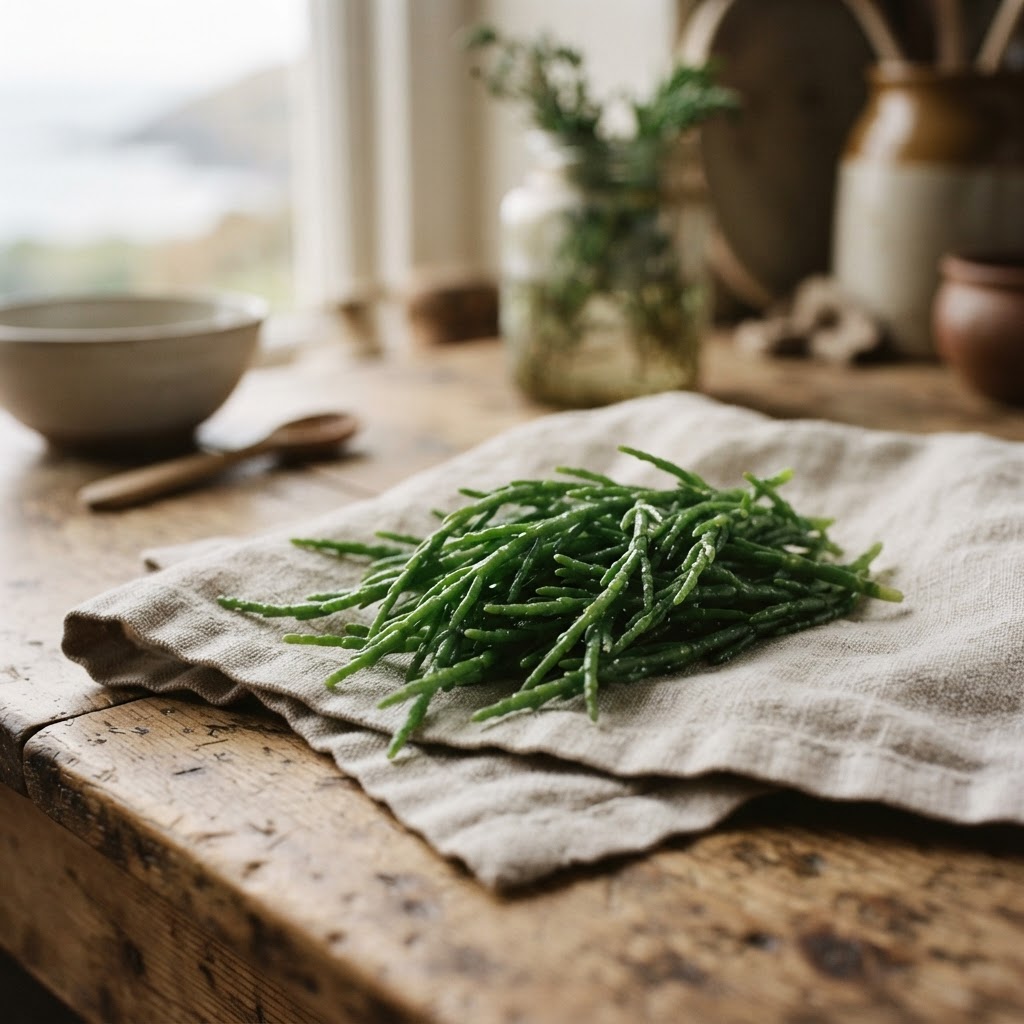
The Samphire
Samphire is a coastal plant — not a true seaweed — that grows on shoreline mud and rocks in bright green, jointed, succulent stems. Eaten briefly blanched or raw, it is crisp, salty and faintly briny, a natural partner for fish. This page follows samphire from shore to plate: how it grows at the water's edge, why it is best lightly cooked, and why its saltiness shapes how you season the rest of the dish.
Varieties
Marsh samphire (Salicornia)
- Looks
- Bright green, jointed, fleshy stems; the common culinary samphire.
- Taste & texture
- Salty, crisp and briny; the kitchen standard.
- Best for
- Blanch, steam, raw, with fish.
Rock samphire (Crithmum maritimum)
- Looks
- Fleshy, aromatic, umbel-shaped leaves on cliffs.
- Taste & texture
- Aromatic and peppery; an acquired, pungent note.
- Best for
- Pickled, sparing garnish.
Seasonality
Northern Europe
June–September (peak summer)Southern Europe / Mediterranean
April–SeptemberNorth America
June–September (where it grows)Ripeness & freshness
Bright green
Stems are bright, clear green; yellowing means age.
Firm and crisp
Stems are firm and snap; limp stems are older.
No browning
No brown or soft tips; fresh tips are bright.
Moist, not wet
Slightly moist, not slimy; slimy means age.
What to look for when buying
Bright and firm
Choose bright, firm, crisp stems; avoid limp or yellowing.
No browning
Pass on bunches with brown or soft tips.
Moist
Slightly moist and fresh, not dry or slimy.
Use quickly
Buy fresh and use within a day or two; it doesn't keep.
Growing, sourcing & harvest
Shoreline plant
Grows on tidal mudflats, salt marshes and rocks at the water's edge.
Wild harvest
Mostly wild-harvested in summer; some cultivated in saline plots.
Sustainable picking
Pick the tops and leave the plant to regrow; only where permitted.
Harvest & post-harvest
- Samphire keeps only 1–2 days refrigerated; it loses crispness fast.
- Keep cool and damp; wrap and refrigerate immediately.
- Use it the day you buy it if you can.
Storage
Wrap damp and refrigerate; use within 1–2 days.
Blanch and refresh; keep a day refrigerated.
Pickled samphire keeps weeks; a way to preserve a glut.
Raw & cooked, and how to cook it
Flavour
Raw
Salty, briny and green; very fresh.
Cooked
Milder and greener; brief cooking keeps the bite.
Texture
Raw
Crisp and succulent; a good crunch.
Cooked
Tender but still firm; overcooking makes it limp.
Colour
Raw
Bright, vivid green.
Cooked
Holds colour if blanched briefly; dulls if boiled.
Blanching, brief
Keeps the crunch and bright colour, softens the salt.
Chef's note —Blanch 30–60 seconds in unsalted water; refresh in iced water.
Steaming, brief
Gentle heat keeps the stems firm and bright.
Chef's note —Steam 2–3 minutes; don't salt the water.
Raw, in salad
A salty, crisp, briny crunch.
Chef's note —Rinse well to remove grit; dress lightly with lemon.
Pan-frying, quick
A fast toss in butter for fish.
Chef's note —Cook 1–2 minutes only; it needs no added salt.
Flavour & texture notes
- Salty and briny
- Green and fresh
- Crisp and succulent
- Best lightly cooked
Flavour notes & harmonies
The top flavour notes of the samphire and what each one harmonises with in dishes. On the left, the strongest notes of the samphire, sized by strength. On the right, the notes outside its profile that each one pairs with most strongly, with the harmony score of each pair.
Each block on the left is one of the top notes, sized by its strength. A stronger note shows more of its harmonies. Bars show the harmony score out of 10. Flavour notes and harmony pairings are curated from verified flavour-pairing reference data.
Colour & plant compounds
Samphire's bright green is chlorophyll, and its salty taste comes from the high salt it takes up growing in seawater — it is a true halophyte. It carries fibre and flavonoids, and is a useful source of minerals, but its high salt means it should season the dish rather than be eaten in bulk. The evidence on its bioactive compounds is limited and figures should be treated with caution.
Chlorophyll
OtherWell establishedFood scienceThe green pigment; set by a brief blanch.
Sodium (sea salt)
OtherWell establishedNaturally high from growing in seawater; season accordingly.
Flavonoids
FlavonoidsEmerging evidenceDetected in Salicornia; part of the plant's polyphenol content.
Waste reduction
Use the tough bases
Tough woody bases flavour stock; use the tender tops for the plate.
Pick a glut
Pickle surplus samphire to keep its salt and crunch for weeks.
Rinse, don't soak
Rinse to remove grit; don't soak, which leaches the salt and flavour.
Sources
USDA FoodData Central does not list samphire; composition taken from peer-reviewed literature.
Australian Tecticornia samphire; composition used as indicative reference.