
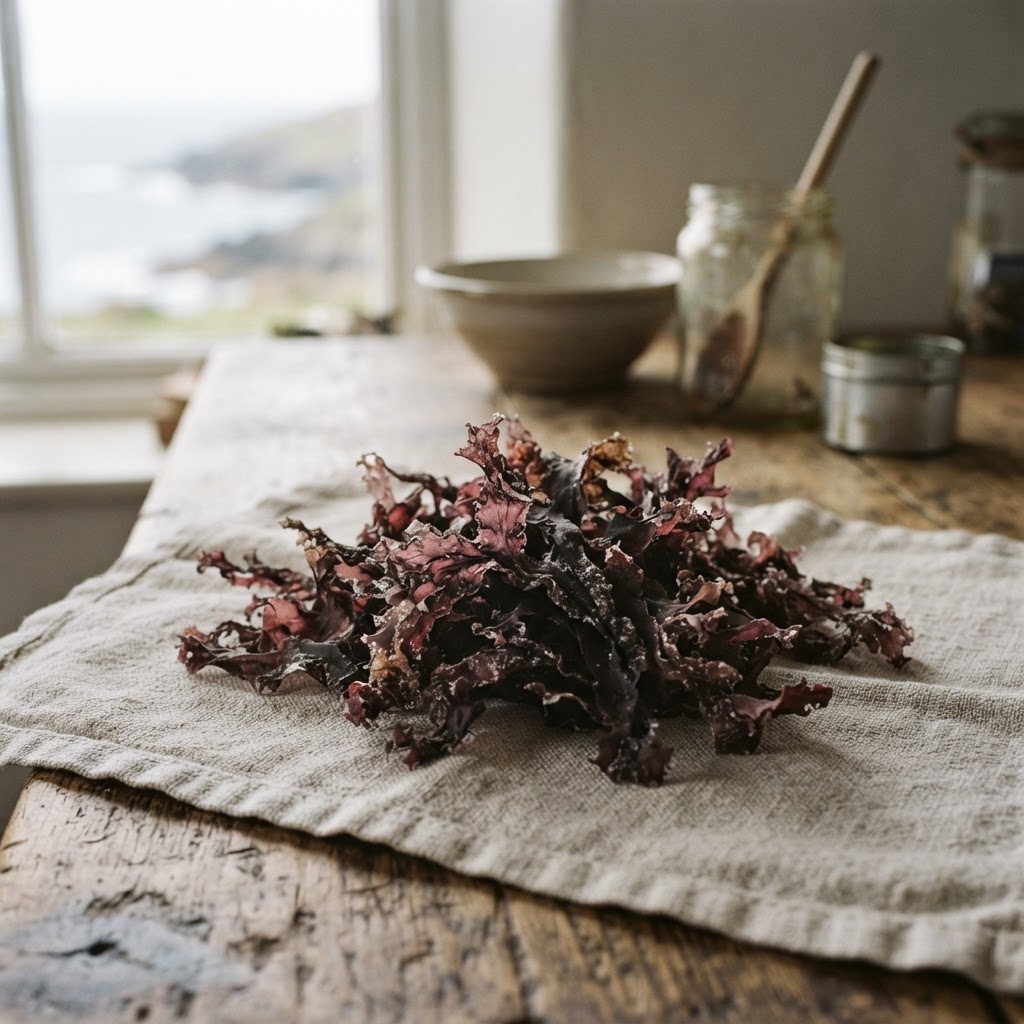
The Dulse
Dulse is a red seaweed (Palmaria palmata) with soft, flat, deep reddish fronds that have been eaten on the Atlantic coasts for centuries. Dried, it is salty and slightly smoky, and it is one of the few seaweeds with a distinctly savoury, almost bacon-like note when pan-fried. This page follows dulse from shore to plate: how it is harvested, why it is usually dried, and what gives it its reddish colour and savoury depth.
Varieties
Dried whole dulse fronds
- Looks
- Flat, deep reddish-purple dried fronds.
- Taste & texture
- Salty, smoky and slightly savoury; the everyday form.
- Best for
- Snack, fry, crumble, broth.
Flaked dulse
- Looks
- Dried and flaked into a reddish seasoning.
- Taste & texture
- Concentrated and salty; a ready sprinkle.
- Best for
- Seasoning, salt substitute, garnish.
Fresh dulse
- Looks
- Soft, damp, dark red fronds, rare outside the coast.
- Taste & texture
- Milder and tender; short shelf life.
- Best for
- Sauté, salad, garnish.
Smoked dulse
- Looks
- Dried fronds cold-smoked for extra depth.
- Taste & texture
- Smoky and savoury; a delicacy.
- Best for
- Snack, garnish, savoury dishes.
Seasonality
North Atlantic (Ireland, Scotland, Iceland, Canada)
Spring–autumn harvest; year-round driedNorthern Europe
Late spring–autumn; dried year-roundNorth America (Atlantic)
Summer harvest; dried year-roundRipeness & freshness
Dry and dark
Dried fronds are deep red-purple and dry; brown or faded means age.
Clean smell
A clean, briny, slightly smoky smell; stale means age.
Supple, not brittle
Dried fronds bend slightly; crumbling to dust means age.
No dampness
Fully dry; any damp or mould means spoilage.
What to look for when buying
Dry and sealed
Choose dry, sealed packets; moisture spoils dried seaweed.
Deep colour
Deep red-purple; avoid brown, faded or grey.
Clean smell
A clean marine-smoke smell; no musty odour.
Whole or flaked
Whole fronds for frying; flaked for seasoning.
Growing, sourcing & harvest
Wild harvest
Mostly wild-harvested at low tide from rocks; some farmed.
Short season
Harvested spring to autumn; cleaned and sun- or kiln-dried.
Atlantic coast
A traditional food of Ireland, Scotland, Iceland and Atlantic Canada.
Harvest & post-harvest
- Dried dulse keeps a year sealed, dry and dark.
- Open packets keep weeks; use before it goes stale.
- Fresh dulse keeps only days; use quickly or dry it.
Storage
Keep sealed, dry and dark; lasts up to a year.
Seal tightly after opening; use within a few months.
Refrigerate and use within a day or two.
Raw & cooked, and how to cook it
Flavour
Raw
Salty, briny and slightly smoky.
Cooked
Pan-frying brings out a savoury, almost bacon-like note.
Texture
Raw
Chewy and leathery when dried; tender when rehydrated.
Cooked
Crisp when fried; softer in a broth.
Colour
Raw
Deep red-purple.
Cooked
Darkens and browns with heat; crisps when fried.
Pan-frying, dry
Crisps the frond and brings out a savoury note.
Chef's note —Fry briefly in a hot dry pan; drain on paper and use at once.
Crumbling, seasoning
A salty, smoky sprinkle over potatoes or eggs.
Chef's note —Crumble dried fronds or flakes just before serving.
Simmering in broth
Adds marine depth and a red tint to a stock.
Chef's note —Simmer briefly; strain or leave the fronds in.
Snack, as-is
Dried fronds eaten straight as a chewy, salty snack.
Chef's note —Keep dry; eat a little at a time.
Flavour & texture notes
- Salty and briny
- Slightly smoky
- Savoury when fried
- Chewy when dried, tender when cooked
Flavour notes & harmonies
The top flavour notes of the dulse and what each one harmonises with in dishes. On the left, the strongest notes of the dulse, sized by strength. On the right, the notes outside its profile that each one pairs with most strongly, with the harmony score of each pair.
Each block on the left is one of the top notes, sized by its strength. A stronger note shows more of its harmonies. Bars show the harmony score out of 10. Flavour notes and harmony pairings are curated from verified flavour-pairing reference data.
Colour & plant compounds
Dulse's deep red colour comes from phycoerythrin and other red pigments, alongside chlorophyll and carotenoids. Its savoury depth is driven by umami amino acids, and it carries sulfated polysaccharides characteristic of red seaweeds. Dulse is also notable for its protein and iodine content, though levels vary and the evidence on absorption is limited; figures should be treated with caution.
Phycoerythrin
OtherWell establishedThe red pigment that gives dulse its deep colour.
Sulfated polysaccharides
OtherEmerging evidenceCell-wall polysaccharides of red seaweeds; part of the frond's fibre.
Iodine
OtherWell establishedNaturally high; content varies and intake should be moderate.
Waste reduction
Use flakes
Flaked dulse is a ready salt substitute; nothing is wasted.
Don't over-soak
Long soaking leaches flavour and salt; keep it brief.
Crisp stale dulse
A brief dry pan-fry restores crispness and aroma.
Sources
USDA FoodData Central does not list dulse; composition taken from peer-reviewed literature.